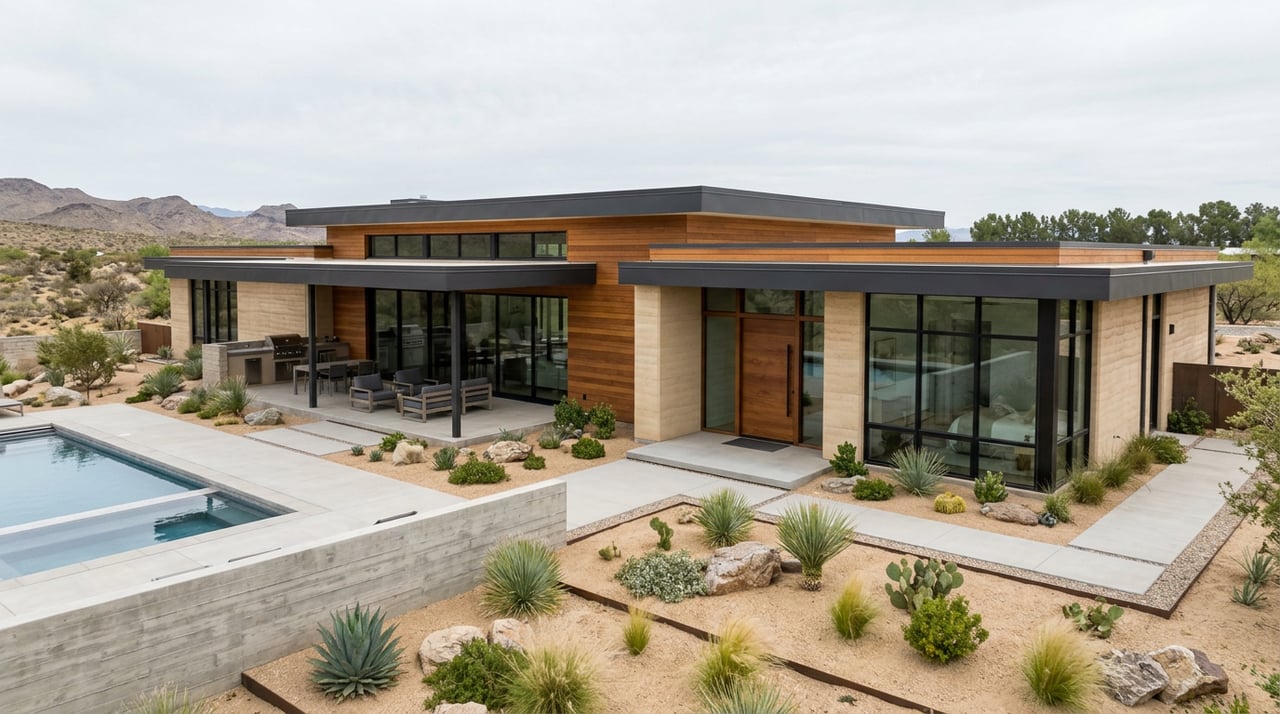
A buyer touring a Sedona listing advertised with an "income-producing guest casita" usually assumes that casita is a second rentable unit from day one. It isn't, not automatically. Since September 2024, Sedona has prohibited renting a detached guest house or accessory dwelling unit as a short-term rental unless the owner lives full-time in the main house on the same parcel. Unless the casita already has documented history as a permitted short-term rental, that second income stream the listing photos implied doesn't exist until you move in yourself, and even then it needs its own separate $210 annual permit under a rule the city added in December 2024. One parcel, two structures, two applications, and a residency requirement that didn't exist two years ago.
That single rule is a symptom of something larger. Sedona and Cottonwood sit about twenty minutes apart on the map and share the same tourist economy, the same red rock and wine country draw, and the same state law protecting an investor's right to operate a short-term rental. But the two cities have been moving their local rules in opposite directions, and two bills currently working through the Arizona legislature could widen that gap or close it entirely, depending on which one survives. Anyone underwriting a short-term rental purchase in either town this year is really placing a bet on timing, not just location.
What the Average Revenue Number Is Hiding
Sedona's numbers look extraordinary on the surface. One short-term rental analytics platform put the trailing 12-month average revenue per listing at $83,895 as of February 2026, with average daily rates reaching $440 earlier in the year. Another tracker reports the market's median host earning closer to $49,245 a year, with top performers pulling in $83,278 or more. Those two figures aren't measuring the same thing, but they point to the same conclusion: the headline average isn't the middle of the market, it's closer to what only the strongest, most established listings achieve. A buyer entering today isn't stepping into the average. They're stepping into whatever a brand-new, unreviewed listing can pull in a market where supply has already outrun demand.
Sedona's active listing count grew from 1,113 in 2021 to 1,805 by February 2026, a 62 percent increase, against a permanent population of just 10,303 residents. Occupancy has declined for four straight years even as that supply kept climbing. Spring still delivers strong performance, with March and April occupancy near 72 percent and monthly revenue above $10,000 in March, and fall holds a secondary peak with October daily rates as high as $471. But a rising average daily rate stacked on falling occupancy is not the same story as a market getting stronger. It's a market where existing operators with reviews and repeat guests can still charge more, while new entrants compete for a shrinking share of nights booked.
Why Sedona Keeps Tightening the Rules
Every restriction Sedona has added in the past two years reads like a response to that saturation, not a reach for extra revenue. The ADU rule in September 2024. The per-unit permit requirement in December 2024. A zero-tolerance ban on special events, weddings, retreats, conferences, workshops, any organized gathering, enforced with fines and permit revocation for up to a year. A requirement that hosts run a sex offender background check on every guest within 24 hours of check-in and keep records for 12 months. Late renewal fees added January 1, 2026, of $50 to $100 depending on how far past due the renewal is. None of these are revenue tools for the city. They're friction, added deliberately, in a market that already has more listings than it did five years ago and less room to absorb new ones without cannibalizing existing hosts.
Arizona's state preemption law prevents Sedona from capping the number of permits it issues or banning short-term rentals outright, so the city has instead been tightening everything short of a cap. The combined tax burden reflects that intensity too: 13.325 percent in the Yavapai County portion of Sedona, 13.90 percent in the Coconino County portion, a blend of state and county tax, a 3.5 percent bed tax, and a 3.5 percent city hotel tax layered on top of a base rental income tax.
Cottonwood's Different Math
Cottonwood took the opposite approach when it adopted Ordinance #731 in March 2023. Registration is required, neighbor notification is expected, and a minimum $500,000 liability insurance policy applies just as it does in Sedona, but there's no ADU restriction on casitas, no ban on special events, and no per-unit permit stacking. The combined tax burden on rental income runs roughly 8 to 9 percent, well under Sedona's rate. Cottonwood's registration form also asks applicants to provide proof of citizenship or legal residency at the time of application, a requirement not mirrored in Sedona's permit process, a small but real difference in what a prospective operator has to produce before they can list a property.
The demand underneath Cottonwood is real but smaller in scale. Old Town Cottonwood's walkable stretch of Main Street and Mingus Avenue, lined with tasting rooms tied to the Verde Valley Wine Trail, draws a steady flow of wine country visitors. The Verde Canyon Railroad departs a few miles away in Clarkdale on a roughly four-hour scenic run through the upper Verde River canyon, and Tuzigoot National Monument's Sinagua pueblo ruins sit on a hilltop nearby, an easy stop for anyone exploring the area. None of that is Sedona's Cathedral Rock, Bell Rock, or Tlaquepaque Arts and Shopping Village, and the revenue numbers reflect the gap. As of April 2026, Cottonwood had 208 active listings, an average daily rate of $195, average annual revenue of $28,318, and an occupancy rate of 36 percent, well under the state's 53 percent benchmark. A separate tracker put Cottonwood's market median closer to $35,065 a year, with top performers above $50,275.
That's a meaningfully softer market on its own terms, not simply Sedona at a discount. Cottonwood's lower cost of entry buys access to a different, thinner demand curve, and the town's own occupancy trailing the statewide average suggests the ceiling on that curve is real.
| Sedona | Cottonwood | |
|---|---|---|
| Governing ordinance | City Code Chapter 5.25 | Ordinance #731 (March 2023) |
| Annual permit/registration | $210 per unit, separate permit per advertised unit since Dec. 2024 | Registration-based, no per-unit stacking rule |
| Combined tax on rental income | 13.325% (Yavapai) / 13.90% (Coconino) | Roughly 8-9% |
| ADU/casita rule | Cannot rent unless owner occupies main house (since Sept. 2024) | No equivalent restriction found |
| Special events | Zero-tolerance ban, permit revocation risk | No equivalent ban found |
| Liability insurance | $500,000 minimum | $500,000 minimum |
| Active listings | 1,805 (Feb. 2026) | 208 (Apr. 2026) |
| Average daily rate | $440 (early 2026) | $195 (Apr. 2026) |
Two Bills That Could Redraw the Map
Both towns are small enough to fall under a threshold that matters right now. Arizona's SB1076, introduced and not yet enacted as of February 2026, would let cities and towns with populations under 70,000 set a maximum number of short-term rental permits and impose minimum distance requirements between properties, a power explicitly withheld from larger cities like Phoenix, Scottsdale, Mesa, and Tempe. Both Sedona, with 10,303 residents, and Cottonwood, with roughly 12,000, fall under that line. If SB1076 becomes law, Cottonwood could cap its own permit count the same way Sedona has already tightened everything else, closing the lighter-touch door that currently makes it attractive to new investors.
A second bill, HB2429, passed the Arizona House 36-19 in March 2026 and was pending in the Senate as of that spring. It would let cities set overnight occupancy formulas and, more importantly, establish permit caps and minimum spacing requirements. For Sedona, where supply already outpaces demand growth, a cap would hand a real advantage to whoever already holds a valid permit when it takes effect. Both bills were moving through this year's legislative session, which will have concluded by the time you read this. Confirm current status before running numbers on either scenario. Neither has been signed into law as of the most recent reporting we found, and Arizona's short-term rental rules have changed enough times since 2016 that treating any pending bill as settled before it passes is a mistake.
What This Means If You're Buying in 2026
The decision isn't Sedona versus Cottonwood on price alone. It's a question of which side of a possible regulatory door you want to be standing on. A Sedona property with an already-secured, compliant permit, particularly one with a casita that has documented prior use predating the ADU rule, holds value that a newly permitted property may not if HB2429 passes and existing holders get grandfathered in. A Cottonwood purchase made before SB1076 resolves buys access to a market that still allows a new entrant to register and operate without competing against a fixed permit ceiling, but the underlying demand there is thinner and the occupancy numbers are already trailing the state average.
Either way, the math you run today assumes rules that are actively being rewritten. Before you write an offer on a short-term rental property in either town, ask specifically whether any casita or guest house on the parcel has documented prior rental history, request a copy of the current permit or registration, and confirm the property's exact tax jurisdiction, since Sedona alone splits between Yavapai and Coconino counties at different combined rates.
Can Sedona cap the number of short-term rental permits it issues right now? No. State preemption under Arizona law prevents Sedona, or any city, from banning short-term rentals or capping permit numbers today. That could change if pending legislation passes.
Does Cottonwood require the same insurance as Sedona? Yes. Both cities require a minimum of $500,000 in liability insurance coverage for short-term rental operators.
If I buy a Sedona property with a guest casita, can I rent it separately from the main house? Only if you occupy the main house on the same parcel full-time, per the rule Sedona added in September 2024, unless the casita already has documented prior use as a permitted short-term rental. Each unit also needs its own separate $210 annual permit.
Which town has the lower tax burden on short-term rental income? Cottonwood, at roughly 8 to 9 percent combined, compared with Sedona's 13.325 percent in Yavapai County or 13.90 percent in Coconino County.
If you're weighing a short-term rental purchase in Sedona or Cottonwood and want a read on how a specific parcel's permit history, tax jurisdiction, and county line affect your numbers, Real Prescott Property Group can walk through the current rules property by property before you write an offer.